
By the Digipath Agency SEO Team | Published August 22, 2026
Google’s August 2026 Spam Update: What It Targets and How to Stay Ahead of It
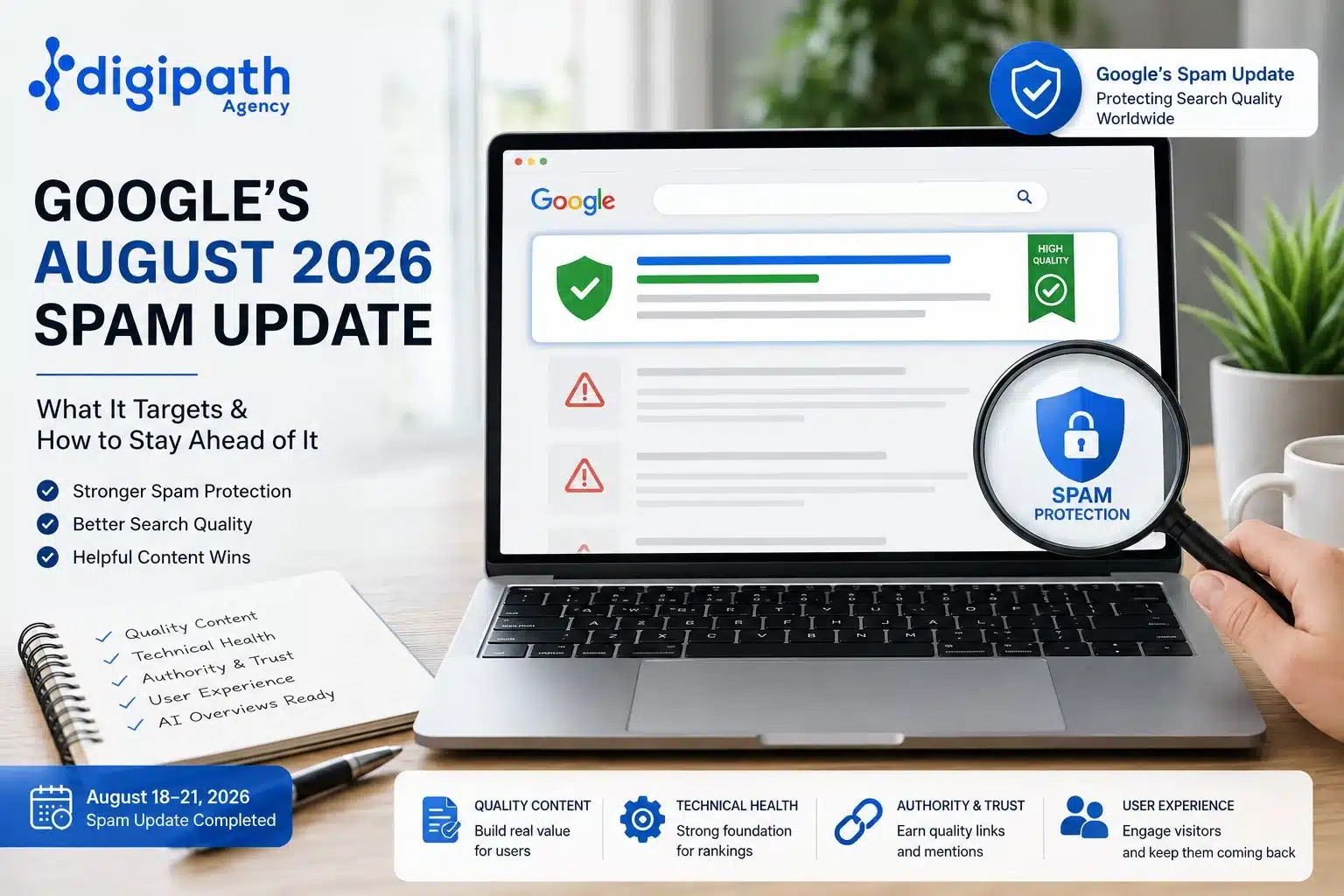
On August 18, 2026, Google quietly flipped the switch on its third spam update of the year. No blog post, no fanfare — just a one-line note on the Search Status Dashboard. By August 21, the rollout was confirmed complete, running about two days and sixteen hours worldwide across every language and region.<cite index=”7-1″>The August 2026 spam update started at 09:27 US Pacific time on 18 August 2026 and Google confirmed it complete on 21 August 2026, a total runtime of about two days and 16 hours.</cite>
If you manage a website — or you’re one of our clients wondering why your traffic dipped last week — here’s what actually happened, what it means, and how to make sure your site is on the right side of it.
What This Update Actually Is
This is Google’s third confirmed spam update of 2026, following rollouts in March and June.<cite index=”3-1″>Google has begun rolling out the August 2026 spam update, applying globally and to all languages, its third one this year.</cite> Unlike a core update, which reshuffles rankings broadly, a spam update is narrower: it sharpens SpamBrain, Google’s automated spam-detection system, to catch sites that are already breaking existing rules more effectively.
A few important clarifications came out during the rollout:
- No new policies. <cite index=”7-1″>The August 2026 spam update was a routine, worldwide upgrade to SpamBrain, the system Google uses to catch spam.</cite> It enforces the rules already published in Google’s spam policies more strictly — it doesn’t add new ones.
- It’s selective. <cite index=”6-1″>This update does not target link spam, it does not target the site reputation abuse policy and some other policies.</cite> It penalizes specific spam techniques rather than acting as a blanket sweep.
- Who’s at risk. <cite index=”7-1″>Sites built on mass-produced content, thin or doorway pages, old bought domains, or AI content made only to win citations were the most at risk.</cite>
- Recovery isn’t instant. <cite index=”7-1″>The rollout is over, so the data is now stable enough to act on, but recovery still takes months rather than days.</cite>
Worth noting: this follows a clarification Google made back in May that its spam policies extend beyond classic search results. <cite index=”3-1″>The June 2026 spam update followed a May 15 clarification that Google’s spam policies also apply to attempts to manipulate generative AI responses in Search, including AI Overviews and AI Mode.</cite> Google hasn’t confirmed August specifically targets that behavior, but the direction of travel is clear: gaming AI Overviews is now treated the same as gaming the blue links.
If your rankings moved during or after August 18–21, that’s the window to check in Search Console. But a spam update rarely explains a dip on its own — it’s usually a symptom of something the site was already doing that fell outside Google’s guidelines. That’s where the bigger picture comes in.
The Real Story: How Google Actually Ranks Pages in 2026
Spam updates penalize the worst offenders. But staying off Google’s radar isn’t a strategy — building a site that genuinely deserves to rank is. Based on leaked internal ranking documentation and independent analysis, here’s what’s actually driving visibility right now.
1. Content Is Still the Biggest Lever
- Full intent match. Rank for what the searcher actually wants to accomplish, not just for containing the right keyword.
- Real depth, not padding. Google’s leaked internal ranking documents reportedly include a signal called contentEffort — an LLM-estimated score of how much genuine work went into a page, meaning thin or spun content reads as low-effort no matter the word count, according to WordStream’s analysis of the leaked ranking factors.
- E-E-A-T. A real, bylined author with credentials; first-hand specifics like original photos, proprietary data, or on-the-ground detail; citations to primary sources.
- Freshness. Updated dates and current facts matter most for anything tied to price, regulation, or season.
- Keyword stuffing now actively hurts. Google’s semantic systems evaluate topical coverage through surrounding context and related terminology, not repetition counts.
2. Technical Health Is the Floor
- Core Web Vitals (LCP, INP, CLS), mobile-first rendering, HTTPS, a clean crawlable structure, and no orphan pages.
- Keywords and entities in the title, H1, URL, and first 100 words — but semantic coverage now outweighs exact-match density.
- Proper canonicals, sitemap inclusion, and internal links that route authority into your money and service pages. (We map this out for clients as part of every SEO audit.)
3. Authority Decides Close Calls
- Backlinks still count, but a linking site’s relevance and trust now outweigh raw volume.
- Length still correlates with links — posts running past 3,000 words pull in roughly three-quarters more backlinks than pieces under 1,000 words, per Analytify’s ranking factors report.
- Digital PR has become this year’s highest-yield link-building tactic, ahead of older outreach methods, according to the same Analytify report.
- Brand mentions — even unlinked ones — and consistent NAP (name, address, phone) data feed authority too.
4. UX and Engagement Signals
- Dwell time, SERP click-through rate, scroll depth, and repeat visits all factor in.
- The leaked navBoost system reportedly re-ranks results using click-behavior signals internally labeled goodClicks and badClicks — pogo-sticking back to the results page counts against you, per WordStream.
- Site-wide topical authority (referred to internally as siteFocusScore/siteRadius) rewards a tightly interlinked cluster of posts on one theme over a single isolated “ultimate guide” — one more reason internal linking strategy matters as much as any single article.
5. AI Overviews and GEO (Generative Engine Optimization)
- Self-contained “answer islands” matter most: compact passages of roughly 130–170 words that fully answer one question on their own are the strongest predictor of getting cited in AI Overviews, according to Wellows’ research on AI Overview ranking factors.
- Validated Article/BlogPosting and FAQPage/HowTo schema is still the fastest route into AI Overviews and rich results.
- Brand recognition compounds here too — AI systems preferentially cite sources users already recognize, so consistent branding across your content feeds AEO (Answer Engine Optimization), not just classic SEO.
Bottom Line
Content depth and intent match set the ceiling. Technical health is the floor nothing else matters without. Backlinks and brand recognition decide close calls between similarly strong pages. And schema plus answer-formatting decide whether you also show up in AI Overviews on top of the standard blue links.
Spam updates like this one aren’t really about catching you off guard — they’re Google cleaning up the sites that never invested in these fundamentals to begin with.
What to Do Right Now
- Audit for thin and AI-spun content. If a page couldn’t survive Google’s contentEffort check, rewrite it with real specifics or consolidate it into a stronger page.
- Check Search Console for the August 18–21 window and compare it against your historical baseline before drawing conclusions.
- Tighten topical clusters. Interlink related posts around a single theme rather than publishing isolated one-off articles.
- Add or validate schema markup on your key content and service pages.
- Review your backlink profile for low-relevance, low-trust links that could be dragging down authority signals.
If that list feels like a lot to tackle on top of running a business, it’s exactly what our team handles day to day — from technical SEO audits and content writing built around real E-E-A-T, to link building focused on relevance over volume. Explore our full SEO services or get in touch for a free consultation, and check out more insights on our blog.
Sources:
- Search Engine Journal — Google Begins Rolling Out The August 2026 Spam Update
- Search Engine Roundtable — Google August 2026 Spam Update
- Orange Monke — Google Releases August 2026 Spam Update: Targets, Risks & Recovery
- WordStream — Google Ranking Factors
- Analytify — Google Ranking Factors
- Wellows — Google AI Overviews Ranking Factors
