
Why are UAE businesses losing customers online without realizing it? Because the losses don’t show up as errors — they show up as silence. A visitor lands, hesitates, and leaves, and your analytics dashboard just logs it as one more bounce. No alert fires, no page breaks, nothing looks “wrong.” The business just quietly gets fewer enquiries and sales than its traffic numbers say it should.
That gap between traffic and results is usually built from a handful of specific, fixable problems: checkout friction, a site that wasn’t really designed for how UAE customers browse, missing trust signals, and — increasingly — being invisible to the AI-generated answers customers now see before they ever click a website.
How much revenue is actually walking out the door?
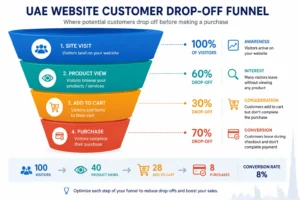
More than most business owners assume. Research aggregated by the Baymard Institute, which has tracked checkout behaviour across dozens of studies since 2006, puts the global average online cart abandonment rate above 70%, and UAE e-commerce stores frequently sit at or above that figure. That means for every ten shoppers who add something to a cart, roughly seven never complete the purchase — and the vast majority of them leave no explanation behind.
Why do UAE shoppers behave differently than shoppers elsewhere?
Three things separate the UAE market from Western e-commerce benchmarks, and templated websites built for other markets tend to miss all three.
Trust has to be earned faster
Card fraud concerns and a comparatively young online retail history mean UAE shoppers look for visible reassurance — clear return policies, recognizable payment logos, real contact details — before they’ll enter card information on an unfamiliar site. If those signals aren’t obvious in the first few seconds, hesitation turns into an exit.
Payment flexibility isn’t optional anymore
Buy-now-pay-later options, Apple Pay, and locally trusted gateways aren’t nice extras in this market — for a meaningful share of shoppers, their absence is the reason a cart gets abandoned rather than completed.
Bilingual isn’t the same as translated
A right-to-left Arabic layout, Arabic payment confirmations, and Arabic-capable support are a different bar than simply having an Arabic toggle bolted onto an English site structure.
Is your site actually built for how UAE customers browse?
The UAE is one of the most mobile-saturated markets in the world. According to DataReportal’s Digital 2026 report on the UAE, the country has close to universal internet penetration and mobile connections that outnumber the population — meaning most UAE customers are meeting your business on a phone, often on the move, often with less patience for a slow or cluttered page than a desktop user would have.
A site that takes several seconds to load, buries the phone number in a footer, or makes a customer pinch-and-zoom to read a price isn’t losing customers to competitors — it’s losing them to its own friction. If nobody has stress-tested your site on a mid-range Android phone over mobile data recently, that’s usually the first place to look.
Are you invisible in the answers customers see before they even click?
Search itself has changed. A growing share of searches in the UAE now end inside an AI-generated summary — Google’s AI Overviews, Bing’s Copilot answers — without a single click to any website. If your content isn’t structured to be pulled into those answers, you’re not just ranking lower, you’re not being shown at all for an increasing number of queries. We broke down what this shift means for UAE businesses and how it changes search strategy in our guide to SEO vs AEO vs GEO in 2026.
Could a recent algorithm update be quietly burying you?
Sometimes the drop isn’t about UX at all — it’s about search visibility eroding without warning. Google’s most recent spam-focused update targeted exactly the kind of thin, AI-generated, or over-optimized content that a lot of UAE business sites unknowingly carry. If your organic traffic has dipped in the past few months with no clear cause, it’s worth reading our breakdown of Google’s August 2026 Spam Update to check whether your site matches the pattern.
What’s the fastest way to find where you’re actually losing customers?
Guessing wastes time and budget. The reliable approach is to trace the actual customer journey — page speed on real devices, checkout steps, trust signals, mobile layout, and how your content performs in both traditional and AI-driven search — and find the specific points where people stop moving forward. A structured SEO audit paired with a focused look at conversion rate optimization is usually enough to surface the two or three fixes doing most of the damage.
Not sure where your site is leaking customers? Book a free consultation with Digipath Agency and we’ll walk you through it.
Frequently Asked Questions
Why is my UAE website losing customers if traffic and rankings look fine?
Traffic and rankings measure whether people arrive — they don’t measure whether the site convinces those people to buy or enquire once they’re there, which is where most silent losses happen.
What’s the average online cart abandonment rate for UAE e-commerce?
UAE e-commerce stores typically see cart abandonment at or above the global average of roughly 70%, based on Baymard Institute benchmark research.
Do UAE customers really behave differently than shoppers in other markets?
Yes — UAE shoppers tend to demand more visible trust signals, more local payment options, and a genuinely bilingual experience before completing a purchase.
Does my site need to work in Arabic, or is English enough for UAE customers?
English-only sites can still convert, but a properly localized right-to-left Arabic experience consistently reduces hesitation for a large share of UAE shoppers.
Can a Google or Bing algorithm update quietly hurt my UAE business without a manual penalty?
Yes — algorithm updates like Google’s spam-focused releases can reduce visibility for thin or over-optimized content without ever triggering a manual action notice.
What’s the fastest way to find where my UAE website is losing customers?
A combined SEO and conversion audit that traces the real customer journey — speed, checkout, trust signals, and AI-search visibility — is the fastest way to pinpoint the leak.
