
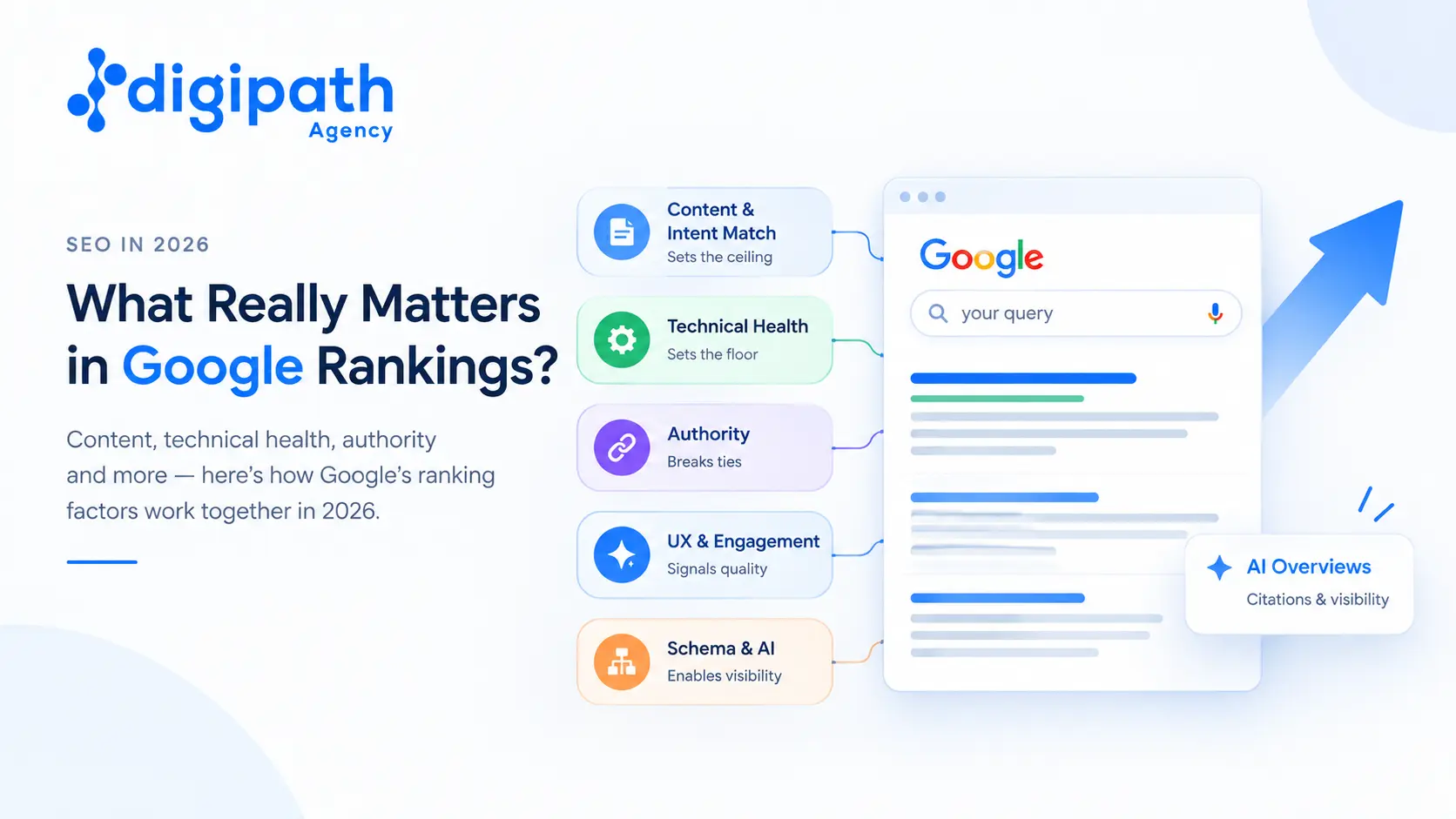
Which Google ranking factor matters most in 2026? Content depth and intent match set the ceiling for how well a page can rank, technical health is the floor nothing can rank without, and backlinks plus brand signals decide close calls between similar pages. Schema and answer formatting then decide whether that same page also gets picked up in AI Overviews. Below is how those layers actually interact, and where to put your effort first.
Content is still the biggest lever — but “content” means something narrower now
Ranking well starts with genuinely matching what the searcher wants, not just containing the keyword they typed. Google’s systems assess topical coverage through the surrounding context and related terminology on a page, not through how many times a phrase gets repeated — so keyword stuffing and templated filler content now work against a page rather than for it.
Depth matters more than length on its own. Reporting on Google’s leaked internal ranking documentation points to a signal referred to internally as content effort — an estimate of how much genuine work went into producing a page, which means thin or AI-spun content can read as low quality regardless of its word count.
Alongside that sits E-E-A-T: a real, credentialed byline, first-hand specifics like original photography or on-the-ground detail, and citations back to primary sources. Freshness plays into this too, particularly for anything tied to pricing, regulation, or seasonality — an outdated fact undermines trust even in an otherwise well-written page.
Technical SEO: the floor, not the ceiling
No amount of content quality compensates for a page that’s slow, broken, or unindexable. The baseline requirements haven’t changed much: strong Core Web Vitals scores (LCP, INP, CLS), mobile-first rendering, HTTPS, a clean and crawlable site structure with no orphan pages, and correct canonical tags.
On-page placement of your target keyword and related entities — in the title, H1, URL, and first hundred words — still helps Google understand what a page is about. But semantic coverage of the topic as a whole now outweighs exact-match density. We covered the mechanics of this in more detail in our SEO vs AEO vs GEO breakdown.
Authority: relevance now matters more than raw link volume
Backlinks are still a meaningful ranking factor, but the relevance and trust of the linking site now outweighs sheer quantity. That said, length and link volume do still correlate — longer, more comprehensive posts tend to attract meaningfully more backlinks than short ones, simply because there’s more in them worth citing.
Digital PR has overtaken older outreach tactics as the highest-yield link-building approach this year. Earned coverage in a relevant publication does more for a domain’s authority than a batch of low-relevance directory links ever will — a distinction we go into further in our guide on choosing a link building service in Dubai.
Brand mentions — even unlinked ones — and consistent business name, address, and phone (NAP) details across the web also feed into how much authority Google assigns a site.
User experience and engagement signals
Dwell time, click-through rate on the results page, scroll depth, and repeat visits all factor into ranking, largely through Google’s reported navBoost system, which re-ranks results based on click behaviour it internally labels as good or bad clicks. A visitor who clicks through and immediately bounces back to the results page — commonly called pogo-sticking — signals that a page failed to satisfy the query.
Site-wide topical authority matters here too. A tightly interlinked cluster of posts covering one theme tends to outperform a single standalone “ultimate guide,” because it demonstrates depth of coverage across an entire subject rather than one page trying to do everything.
Practical takeaway for UAE sites: if your site publishes occasional one-off posts across unrelated topics, you’re leaving topical authority on the table. Building out a cluster — a pillar page plus several supporting posts that link to each other — usually outperforms the same word count spread across disconnected articles.
A quick note on AI Overviews
Everything above still determines whether Google trusts a page enough to rank it — and increasingly, whether it trusts that page enough to cite it inside an AI Overview. That side of the equation, including how to structure content and schema specifically for answer-engine visibility, is its own topic: we’ve covered it in full in how to get your UAE business cited by ChatGPT and AI Overviews and in our SEO vs AEO vs GEO breakdown.
Where these factors fit together
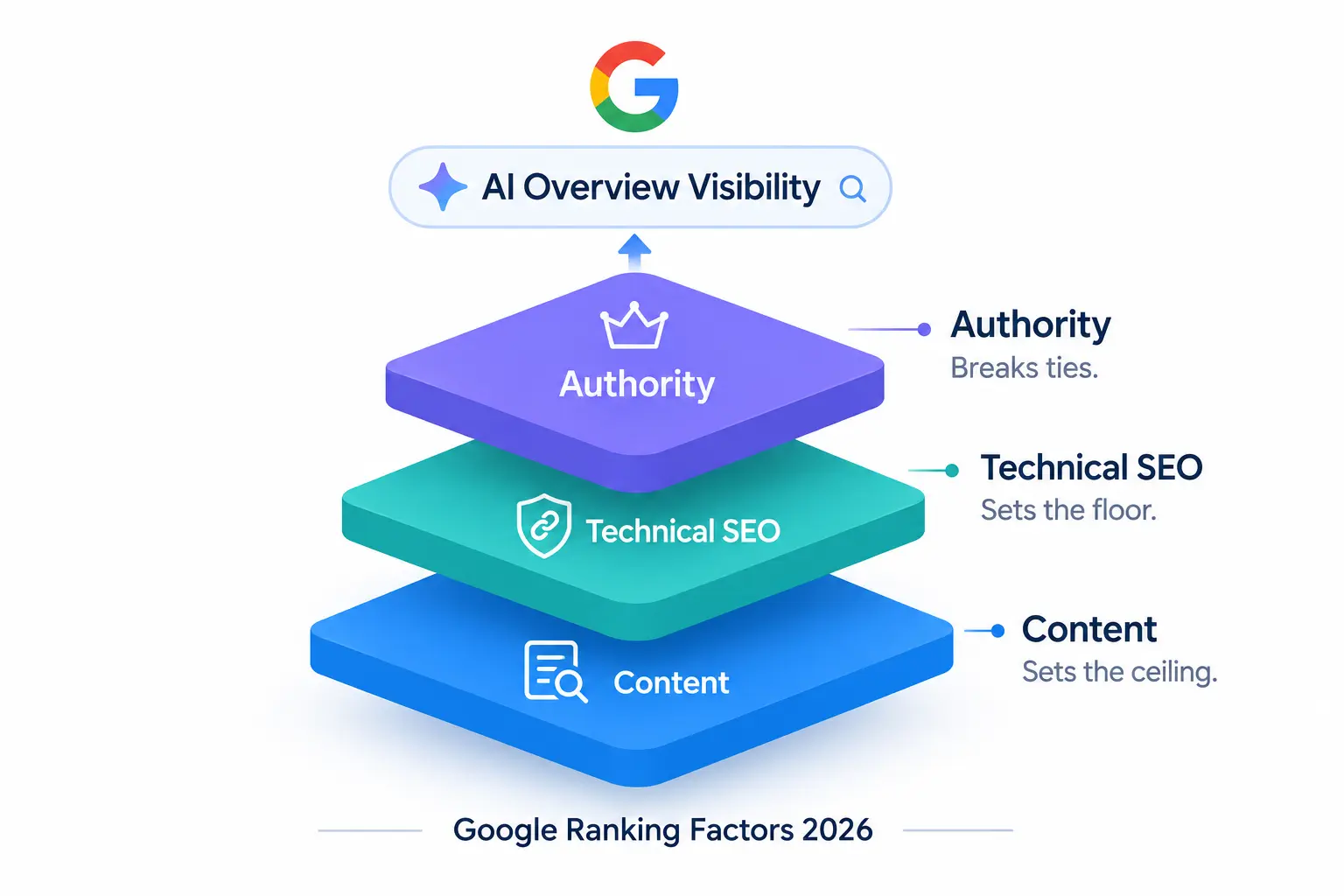
| Layer | Role | What happens if it’s weak |
|---|---|---|
| Content depth & intent match | Sets the ceiling on ranking potential | Page plateaus regardless of other work |
| Technical health | The floor — a prerequisite | Page may not get crawled or ranked at all |
| Authority (links, brand, mentions) | Breaks ties between similar-quality pages | Loses to competitors with weaker content but stronger authority |
Want a site audit against these exact layers? Our SEO audit service checks content depth, technical health, authority, and AI-search readiness in one pass.
Frequently asked questions
What is the single most important Google ranking factor in 2026?
There isn’t one factor that overrides the others — content depth and intent match set the ceiling, technical health is a non-negotiable floor, and authority decides close contests between otherwise similar pages.
Does word count still matter for SEO?
Word count alone isn’t a ranking factor, but longer, genuinely comprehensive content tends to attract more backlinks and cover a topic in enough depth to satisfy search intent, which indirectly helps rankings.
What is content effort in Google’s ranking systems?
Content effort refers to a reported internal signal that estimates how much genuine work went into producing a page, helping Google’s systems distinguish thin or AI-generated filler from substantively researched content.
Do these ranking factors also affect AI Overviews?
Yes — strong content and technical health are prerequisites for AI Overview citation too, but the formatting and schema work needed to actually get cited is a separate step, covered in our dedicated guide on getting cited by AI Overviews.
Do backlinks still matter for SEO in 2026?
Yes, but the relevance and trust of the linking site now matters more than the total number of links, making earned digital PR coverage more valuable than bulk directory or marketplace links.
What are Core Web Vitals and why do they matter?
Core Web Vitals measure loading speed (LCP), interactivity (INP), and visual stability (CLS). They form part of the technical baseline a page needs to meet before content quality can influence its ranking.
